Journal
Traditional Shipyards of Sulawesi: A Complete Regional Guide
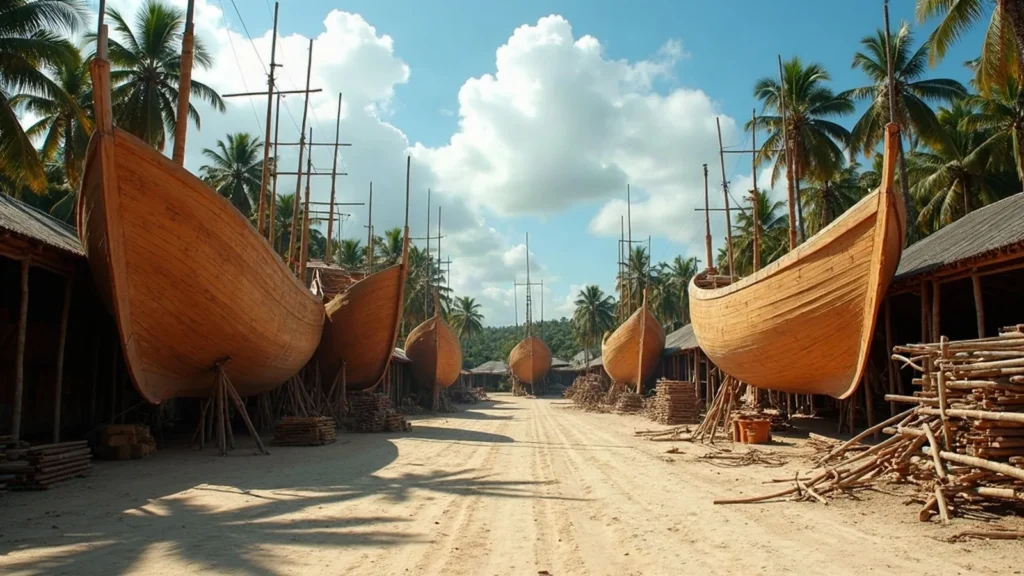
Sulawesi’s traditional shipyards are not one industry but several, separated by hundreds of kilometres and by genuinely different boatbuilding cultures. Understanding that geography is the first practical step for anyone commissioning a vessel here, because the coast you choose decides the hull you can get.
The southern timber coast
The best-known traditional boatbuilding area in Indonesia runs along the southern tip of South Sulawesi, through Bulukumba Regency. The villages of Tana Beru, Bira and Ara sit within a short drive of one another and between them account for most of the large timber schooner hulls built in the country today.
What makes this coast distinctive is not just volume but method. Hulls are built directly on the sand, without covered halls, dry docks or lifting equipment. Shipwrights known as panrita lopi work plank-first, shaping and fastening the outer shell before internal framing is fitted, and reading the hull form by eye rather than from a lofted set of frames.
For an owner, this coast is the right answer when the vessel is a large timber hull and the wrong answer for almost anything else. There is no marine supply district here, no slipway, and no resident surveyor community. Everything technical arrives by road.
The Mandar coast in West Sulawesi
North along the western seaboard, West Sulawesi is Mandar country, and the Mandar boatbuilding tradition is a different discipline altogether. The signature craft is the sandeq, a slender outrigger sailing canoe built for speed under sail, historically used for fishing and trading and now also raced competitively.
The Mandar tradition is about lightness and sailing performance rather than tonnage. It rarely appears in a commercial charter project, but it matters to the island’s picture because it shows that Sulawesi boatbuilding is a family of traditions rather than a single one.
Working hulls in the southeast
Kendari and the Southeast Sulawesi coast build and maintain the working fleet: coastal ferries, fishing vessels, cargo carriers and the steel and timber hulls that move people and goods around the eastern archipelago.
Yacht-standard interior work is not the local specialism, but repair capacity, slipway access and practical structural competence are. For a vessel operating in the Banda Sea, Kendari is often the nearest realistic yard.
Fibreglass and the north
North Sulawesi runs on a different maritime economy again. Bitung is one of Indonesia’s significant fishing ports, and the dive industry around Manado and Bunaken sustains a steady demand for fibreglass and light alloy day boats, tenders and dive craft.
Builders here are working in composites and aluminium rather than tropical hardwood, and the distance from the southern timber coast is substantial. Treat the north as its own market rather than as an extension of the pinisi tradition.
What the regional split means for your project
Most well-run Sulawesi projects end up split across regions by phase rather than concentrated in one place. The hull is built where the skill and timber are; machinery, systems and haul-out happen where the infrastructure is; and documentation and survey run out of Makassar.
That is not inefficiency. It is the rational response to an island where boatbuilding capability and port infrastructure sit in different places. Planning for the split from the start avoids the much more expensive discovery that a finished hull is four hours by road from the nearest slipway.
Visiting responsibly
The beach yards are working sites on public shoreline, and they are also, increasingly, on tourist itineraries. Both things are true and they sit uneasily together. Arrange access rather than walking in, ask before photographing a hull under construction, and stay clear of overhead loads and hot work.
If you are visiting as a prospective client rather than as a traveller, bring a written agenda. A visit that produces a scope, a species list and a milestone conversation is worth ten that produce photographs.
A note on how quickly this picture changes
Capability on this coast is not static. A yard that completed a well-supervised charter hull last year has different capacity, cash position and crew availability this year, and the reverse is equally true of one that has just lost its most experienced foreman.
That is why we describe clusters and capabilities rather than naming yards as recommendations. A recommendation published today would be stale within a season and misleading within two. What holds steady is the regional geography: which coast builds which hull, what infrastructure exists nearby, and what has to be trucked in. Build your shortlist on the stable layer and verify the volatile layer at the time you actually need it.
Frequently asked questions
Which village should I go to first?
If your project is a large timber hull, the Bulukumba coast around Tana Beru, Bira and Ara is where to start looking. But go with a shortlist logic rather than a village name, because the useful distinction between yards there is capability, supervision access and documentation practice rather than which village they sit in.
Are these yards registered businesses?
It varies widely. Some operate as formal companies and some as family enterprises with limited formal documentation, which is one of the reasons contracting, payment structure and document control matter so much on this coast. Verify who you are actually contracting with before any money moves.
Can these yards build to a drawing?
Many can and do, particularly on larger commissioned projects. The traditional method does not require a lofted frame set, so building to a naval architect’s drawings is a different mode of working that should be agreed and priced explicitly rather than assumed.
How many distinct boatbuilding regions does Sulawesi actually have?
Four working clusters, plus a gateway. The southern coast of South Sulawesi builds large timber hulls; the Mandar coast of West Sulawesi builds light, fast sailing craft; Kendari and the southeast maintain the working fleet; Bitung and Manado in the north work in fibreglass and alloy. Makassar is not a building cluster but the documentation, survey and logistics gateway that most projects pass through at least once.
Do I need to travel to Sulawesi before I can shortlist a yard?
No. A defensible first shortlist can be built remotely from recent hull records, current order-book status, photographs of work in progress and a clear statement of who the contracting party would be. Travel matters at the second stage, when one structured visit with a written agenda settles capability questions that photographs cannot, and it is far cheaper to visit three shortlisted yards than ten unfiltered ones.
Talk to the Sulawesi Boat Builder desk
Send the vessel type, target length, intended operating area and your build or purchase window. We reply with the shortlist logic, the document set you will need, and the next verifiable step.
WhatsApp +6281139414563 · bd@juaraholding.com
Quotations, contracts and milestone schedules are issued in USD by PT Komodo Galangan Nusantara.