Journal
Wooden vs Fibreglass Boats for Sulawesi Charter Routes
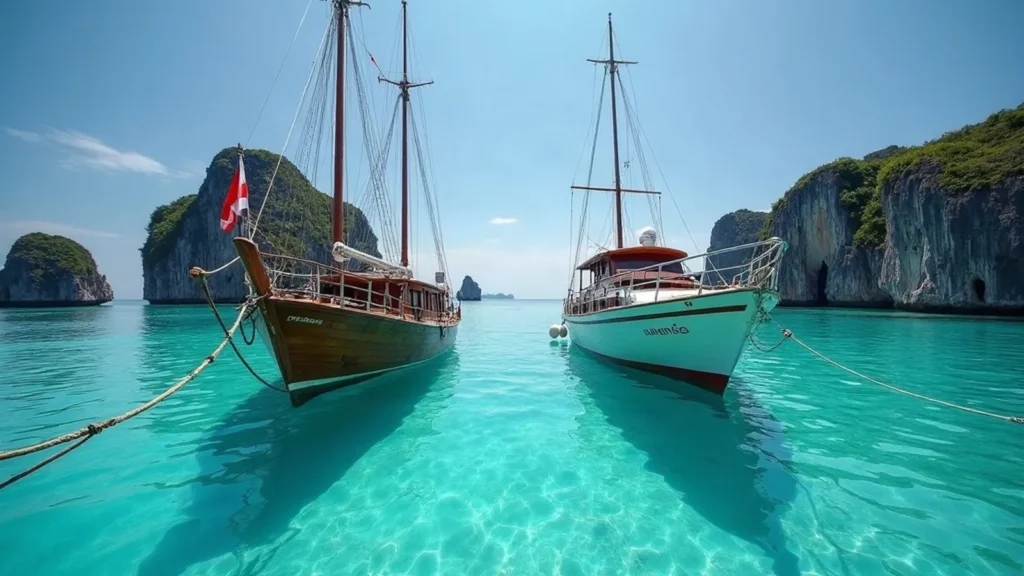
The hull material decision is an operating decision disguised as a construction decision. Timber, fibreglass and aluminium each imply a different maintenance regime, a different repair reality in remote waters, and a different guest expectation. This compares them against the way charter vessels actually work in eastern Indonesia.
The operating profiles are genuinely different
A large timber liveaboard is a slow, heavy, seakindly platform that carries guests for multi-night itineraries. A fibreglass catamaran or fast day boat is a different product: shorter trips, higher speed, higher utilisation, lower crew count per guest.
Before comparing materials, be clear which business you are in. The two rarely compete for the same customer, and choosing the material first and the business model afterwards is how operators end up with a vessel that cannot profitably serve the market they wanted.
Maintenance reality
Timber requires consistent attention: seams, caulking, coatings, fastenings and the annual yard period are not optional. Neglect compounds, and a timber hull that has been neglected for three years is a structural project rather than a maintenance one.
Fibreglass is more forgiving of routine neglect but harder to repair well in remote areas, because a proper laminate repair needs materials, conditions and skills that are not universally available in eastern Indonesia. Aluminium is light and durable but demands disciplined management of electrolysis and coatings.
| Timber | Fibreglass | Aluminium | |
|---|---|---|---|
| Routine maintenance | High and continuous | Moderate | Moderate |
| Repairability in remote Indonesia | Excellent; skills and material are local | Limited; needs materials and conditions | Limited; needs skilled welding |
| Tolerance of neglect | Low | Higher | Moderate |
| Weight and fuel | Heavy, slow, economical at low speed | Light, faster, higher fuel at speed | Light, fast, efficient |
| Guest perception in Indonesia | Strongly positive for liveaboard charter | Neutral, expected for day and dive boats | Neutral |
| Resale market | Established in Indonesia | Established for small craft | Narrower |
Repairability is the underrated factor
This is where timber wins in a way that surprises owners from other markets. If a wooden hull is damaged in eastern Indonesia, the skills and the material to repair it exist within the region, and the repair can be executed to a genuinely good standard by people who build these hulls for a living.
A fibreglass hull damaged in the same place may need to be moved to a facility that can do a proper laminate repair, and a bad repair is worse than none. For a vessel operating far from infrastructure, that difference is operationally significant.
What guests actually respond to
In the Indonesian liveaboard market, a well-presented timber vessel is part of the product. Guests book a pinisi partly because it is a pinisi, and the aesthetic and the story are commercial assets that translate into rate.
For dive day boats and fast transfers, guests care about speed, dryness and safety, not material. Building a timber day boat to satisfy an aesthetic preference that the customer does not have is spending money in the wrong place.
Cost over the life of the vessel
Timber generally costs less to build in Sulawesi and more to maintain. Fibreglass generally costs more to build to a good standard locally and less to maintain routinely. Neither is universally lower in whole-life cost, and the crossover depends on utilisation, itinerary and operator discipline.
The number that decides it is the maintenance reserve. An operator who reserves properly for a timber hull runs a healthy vessel and a predictable business. An operator who does not will find that the material choice made a bigger difference than any spreadsheet suggested.
Crew skills follow the material
Hull material quietly determines what kind of crew you need. A timber vessel wants crew who understand what a working seam sounds like, who check bilges as a habit rather than a checklist item, and who can carry out competent running repairs with the materials available in eastern Indonesia.
Those people exist in numbers in this region precisely because the timber fleet exists. A fibreglass or alloy vessel needs a different competence set, weighted toward systems and machinery, and in remote operating areas the depth of that labour pool is thinner. Factor recruitment and retention into the material decision, because the finest hull in the fleet is only as good as the people looking after it at three in the morning.
Frequently asked questions
Which is better for a Komodo or Raja Ampat liveaboard?
For multi-night crewed liveaboard charter, a well-built and well-maintained timber vessel remains the market-standard product, both for seakindliness at low speed and because guests are actively seeking that experience. For dive day boats and fast transfers within those areas, fibreglass or aluminium is the more rational choice.
Is a wooden hull safe for commercial passenger operation?
Yes, when built and maintained to the applicable standard. The material is not the safety variable; construction standard, stability, fire and escape arrangements, systems and maintenance discipline are. Those are governed by the certification path you choose at specification stage, not by whether the hull is timber.
How much should I reserve annually for a timber hull?
Enough that the annual yard period and a periodic structural programme are funded before they are needed rather than found in a crisis. The precise figure depends on hull age, condition, utilisation and how the vessel is operated, and it should come out of a survey-informed plan rather than a rule of thumb.
Kapan kapal fiber lebih masuk akal daripada kapal kayu untuk operasi wisata?
Untuk operasi day-trip berkecepatan tinggi, armada seragam dengan banyak lambung identik, dan operator yang ingin jadwal perawatan minimal, fiber biasanya lebih rasional. Kapal kayu unggul justru di segmen liveaboard dan pengalaman: karakter, kenyamanan di laut, dan nilai budaya yang menjadi alasan tamu memilih kapal itu. Pilih berdasarkan model bisnis dan rute, bukan berdasarkan anggapan bahwa satu bahan selalu lebih baik.
What maintenance difference should an operator actually budget for?
A wooden hull needs a disciplined annual haul-out with caulking, plank and fastening checks, and periodic recoating; the labour to do this well exists in Sulawesi and is affordable. A fibreglass hull trades that for gelcoat care, osmosis checks and hardware maintenance. Engines, electrics and safety equipment cost the same on both. The wooden boat costs more hours; whether it costs more money depends on where those hours are bought.
Talk to the Sulawesi Boat Builder desk
Send the vessel type, target length, intended operating area and your build or purchase window. We reply with the shortlist logic, the document set you will need, and the next verifiable step.
WhatsApp +6281139414563 · bd@juaraholding.com
Quotations, contracts and milestone schedules are issued in USD by PT Komodo Galangan Nusantara.