Journal
The Future of Pinisi in the Age of Fibreglass and Steel
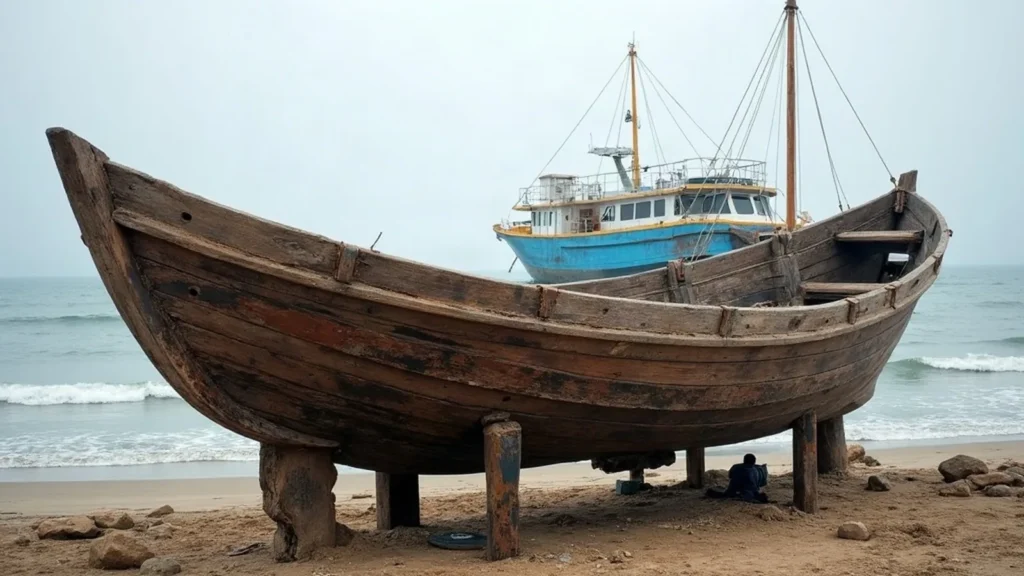
Timber boatbuilding in Sulawesi is not dying, but it is narrowing. Steel and fibreglass have taken the working fleet, and the timber tradition has retreated into the segment where its qualities are commercially decisive: charter liveaboards. Whether that is a stable position depends mostly on timber supply and on who chooses to learn the trade.
What has already been lost
The cargo trade that sustained pinisi construction for centuries has largely moved to steel vessels and containerised shipping. The economics are not close: a steel hull carries more, needs less maintenance per tonne-mile, and can be built to a schedule.
The working fishing fleet has similarly moved substantially toward fibreglass and steel. What remains for timber is not a general boatbuilding industry but a specialised one.
Why charter saved the tradition
The liveaboard charter industry values exactly what makes timber uncompetitive elsewhere: appearance, tradition, low speed comfort and a story. Guests are not buying tonne-miles; they are buying an experience in which the vessel itself is part of the product.
That is a real and durable commercial basis. A well-run charter pinisi generates revenue per displacement tonne that no cargo vessel could approach, and it does so precisely because it is wooden and traditional.
The timber constraint
The most serious threat is material. Ulin in particular is a constrained resource with long growth cycles, and legality requirements have narrowed the accessible supply further.
The industry is responding in the ways available to it: alternative species for some elements, more careful use of premium timber where it matters most, and in some cases hybrid construction. None of these fully substitutes for good ironwood in a keel, and honest projects plan around availability rather than assuming it.
Skills transmission
A tradition transmitted by apprenticeship depends on young people choosing to enter it. Beach boatbuilding is physically hard, seasonal and exposed, and it competes with other work available to the same people.
Where the sector is healthy, it is because the work pays and is steady enough to build a life around. That points to a conclusion owners may find uncomfortable: paying properly and contracting professionally is not charity toward the tradition, it is the mechanism by which the tradition continues to exist.
What modernisation actually looks like
The realistic future is not a choice between pure tradition and industrial production. It is traditional hull construction combined with naval architecture where a rule set applies, documented materials, modern systems and professional project management.
Yards that have made that combination work are getting the best projects. Yards that have not are competing on price in the part of the market where price is the only variable, which is a difficult place to be.
- Traditional plank-first hull construction retained where it performs well
- Naval architecture engaged where class or NCVS applies
- Documented timber supply with pre-agreed alternates
- Modern systems specified and installed to a defined standard
- Inspection-linked milestone contracting as normal practice
- Documentation as a deliverable rather than an afterthought
A realistic outlook
Expect fewer yards, building better-documented vessels, for a market that is smaller in unit terms and larger in value. Expect timber to become more expensive and more carefully allocated. Expect the yards that survive to be those that can satisfy a verifier.
That is a narrowing, not an ending. The craft that produces these hulls is genuinely difficult to replicate, and difficult things that people still want tend to find a price.
What would actually secure the tradition
Three things, none of them sentimental. A documented and sustainable hardwood supply, so that material availability stops being the binding constraint. A steady flow of well-specified, properly paid commissions, so that the trade offers a livelihood competitive with alternatives. And documentation practice good enough that these vessels satisfy insurers and verifiers without argument.
All three are commercial rather than cultural interventions, and all three are influenced by what owners choose to require and pay for. Heritage designations and festivals are pleasant, but a tradition is preserved by a functioning order book far more reliably than by recognition. That is the honest position, and it puts more responsibility on clients than most heritage narratives do.
Frequently asked questions
Will pinisi still be built in twenty years?
Almost certainly, but probably by fewer yards building higher-value vessels for the charter market rather than as a general boatbuilding industry. The determining factors are hardwood availability, whether the trade continues to attract young shipwrights, and whether yards can meet the documentation expectations of insurers and verifiers.
Are yards using modern methods now?
Increasingly, in combination rather than in replacement. Power tools, modern fastenings, epoxy and coatings systems are common, and naval architecture is engaged where class or NCVS applies. The shaping of the hull itself largely remains a matter of shipwright judgement rather than a drawn frame set.
Should I build in steel instead?
For a working vessel, quite possibly. For a charter liveaboard in Indonesia, the timber vessel is what the market is asking for, and that commercial reality usually outweighs the maintenance advantages of steel. Decide by what the vessel has to earn, not by which material is technically more convenient.
Will fibreglass eventually replace wooden phinisi completely?
In the working fleet the economics push that way, and the shift is visible in fishing and utility hulls. The charter and heritage segment runs on different logic: guests book a phinisi for what it is, and that demand keeps skilled timber construction commercially viable. The real long-term constraints are legal timber supply and the transmission of shipwright skills to the next generation, not competition from resin.
Are hybrid timber-and-composite builds actually happening?
Yes, in several forms: protective sheathing over planked hulls, laminated structural members where long clear timber is scarce, and mixed-material superstructures on timber hulls. Each solves a real problem and each carries survey and maintenance implications that differ from pure traditional construction, so the decision belongs in the specification stage with the surveyor consulted, not improvised at the yard mid-build.
Talk to the Sulawesi Boat Builder desk
Send the vessel type, target length, intended operating area and your build or purchase window. We reply with the shortlist logic, the document set you will need, and the next verifiable step.
WhatsApp +6281139414563 · bd@juaraholding.com
Quotations, contracts and milestone schedules are issued in USD by PT Komodo Galangan Nusantara.